
The PM Surya Ghar Muft Bijli Yojana is the Government of India's flagship scheme to put rooftop solar on one crore homes. For a typical family in Vadodara or anywhere in Gujarat, it is the easiest way to cut the electricity bill sharply — and in many cases bring it close to zero — while getting a direct subsidy into your bank account.
This guide explains the scheme in plain language so you can decide whether it is right for your home.
What the scheme offers
Under the scheme, a residential electricity consumer installs a grid-connected rooftop solar system through a registered vendor, gets a net meter from the DISCOM (MGVCL, UGVCL, DGVCL or PGVCL in Gujarat), and then receives Central Financial Assistance (CFA) directly in their bank account.
As per the scheme guidelines at the time of writing, the central subsidy works like this:
- ₹30,000 per kW for the first 2 kW of capacity
- ₹18,000 per kW for the 3rd kW
- Maximum ₹78,000 for systems of 3 kW and above
So a 1 kW system gets about ₹30,000, a 2 kW system about ₹60,000 and a 3 kW (or bigger) system the maximum ₹78,000.
Note: Subsidy amounts and rules can be revised by the Ministry of New and Renewable Energy (MNRE). Always check the latest figures on the official portal pmsuryaghar.gov.in before you decide.
Who is eligible?
- You must be a residential electricity consumer with your own connection in your name.
- The house must have a suitable roof (RCC terrace, sheet roof or other strong roof) with shadow-free space.
- You should not have already taken a central subsidy for rooftop solar on the same connection.
- The system must use DCR (Domestic Content Requirement) solar panels — panels made with Indian cells — and be installed by a vendor registered on the portal.
Which system size should you choose?
A simple rule: look at your average monthly units (kWh) from the last 12 bills.
| Average monthly consumption | Suggested system size |
|---|---|
| Up to 150 units | 1 – 2 kW |
| 150 – 300 units | 2 – 3 kW |
| Above 300 units | 3 kW or more |
In Gujarat, 1 kW of well-installed rooftop solar typically produces around 4 to 5 units per day on average across the year. A 3 kW system can therefore produce roughly 350–400 units in a good month. Read our guide on how much power 1 kW generates in Gujarat for details.
Step-by-step: how the process works
- Register on the national portal with your state, DISCOM and consumer number.
- Apply for rooftop solar and select a registered vendor.
- Feasibility approval is given by the DISCOM.
- Installation is done by your vendor using DCR panels and approved inverters.
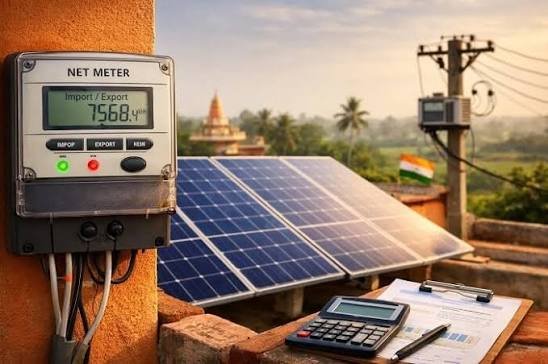
- Net meter application and installation by the DISCOM after inspection.
- Commissioning certificate is generated on the portal.
- Subsidy is credited to your bank account after you submit bank details.
We have written a detailed step-by-step application guide if you want to follow every screen.
How much will you actually save?
Suppose your family uses 300 units a month. A 3 kW system producing around 330–360 units a month can cover most of that consumption. After subsidy, many families recover their investment in roughly 3 to 5 years, and the panels keep working for 25 years or more. That means two decades of nearly free daytime electricity.
Common mistakes to avoid
- Choosing the cheapest quote blindly — poor structures and thin cables reduce output and safety.
- Ignoring shadows from water tanks, parapet walls or neighbouring buildings.
- Skipping earthing and lightning protection — these are essential for safety.
- Wrong name or bank details on the application, which delays the subsidy.
Frequently asked questions
Can I get PM Surya Ghar subsidy if my house is rented?
The subsidy is linked to the residential electricity connection. The consumer whose name is on the bill applies, so tenants usually need the owner's consent and the owner's connection details. Discuss roof rights and ownership of the system with the owner before applying.
Is the subsidy paid to the vendor or to me?
Under the scheme, the central subsidy is credited directly to the bank account of the consumer after the system is commissioned and bank details are submitted on the portal. You pay the vendor the full system price as agreed.
Can I install more than 3 kW and still get subsidy?
Yes. You can install a larger system if your sanctioned load and roof allow it. The subsidy amount is capped at the 3 kW level, so the extra capacity is paid for fully by you — but it still saves money on your bill.
Why the installer matters
The subsidy is the same whoever installs your system, but the quality is not. A licensed electrical contractor designs the cabling, protection devices and earthing correctly, so your plant performs safely for decades.
At Naksh Power Solution, we handle the complete process — site survey, design, DCR panels, installation, net-metering paperwork and subsidy support. Request a free solar quotation or try our solar savings calculator to see what you could save.


